Star-Delta Connection of Transformer
May 3, 2012 29 Comments
(4) Star-Delta Connection:
- In this type of connection, then primary is connected in star fashion while the secondary is connected in delta fashion as shown in the Fig.
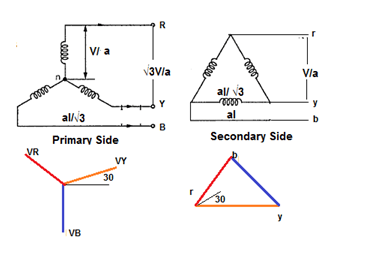
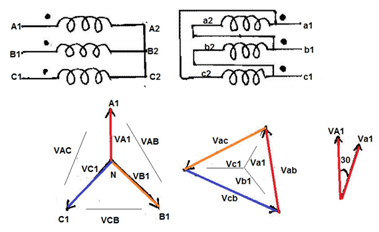
- The voltages on primary and secondary sides can be represented on the phasor diagram as shown in the Fig.
Key point:
- As Primary in Star connected
- Line voltage on Primary side = √3 X Phase voltage on Primary side. So
- Phase voltage on Primary side = Line voltage on Primary side / √3
- Now Transformation Ration (K) = Secondary Phase Voltage / Primary Phase Voltage
- Secondary Phase Voltage = K X Primary Phase Voltage.
- As Secondary in delta connected:
- Line voltage on Secondary side = Phase voltage on Secondary side.
- Secondary Phase Voltage = K X Primary Phase Voltage. =K X (Line voltage on Primary side / √3)
- Secondary Phase Voltage = (K/√3 ) X Line voltage on Primary side.
- There is s +30 Degree or -30 Degree Phase Shift between Secondary Phase Voltage to Primary Phase Voltage
Advantages of Star Delta Connection:
- The primary side is star connected. Hence fewer numbers of turns are required. This makes the connection economical for large high voltage step down power transformers.
- The neutral available on the primary can be earthed to avoid distortion.
- The neutral point allows both types of loads (single phase or three phases) to be met.
- Large unbalanced loads can be handled satisfactory.
- The Y-D connection has no problem with third harmonic components due to circulating currents inD. It is also more stable to unbalanced loads since the D partially redistributes any imbalance that occurs.
- The delta connected winding carries third harmonic current due to which potential of neutral point is stabilized. Some saving in cost of insulation is achieved if HV side is star connected. But in practice the HV side is normally connected in delta so that the three phase loads like motors and single phase loads like lighting loads can be supplied by LV side using three phase four wire system.
- As Grounding Transformer: In Power System Mostly grounded Y- ∆ transformer is used for no other purpose than to provide a good ground source in ungrounded Delta system. Take, for example, a distribution system supplied by ∆ connected (i.e., un-grounded) power source. If it is required to connect phase-to-ground loads to this system a grounding bank is connected to the system, as shown in Figure
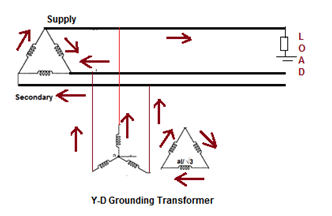
- This system a grounding bank is connected to the system, as shown in Figure. Note that the connected winding is not connected to any external circuit in Figure.
- With a load current equal to 3 times i, each phase of the grounded Y winding provides the same current i, with the -connected secondary winding of the grounding bank providing the ampere-turns required to cancel the ampere-turns of the primary winding. Note that the grounding bank does not supply any real power to the load; it is there merely to provide a ground path. All the power required by the load is supplied by two phases of the ungrounded supply
Disadvantages of Star-Delta Connection:
- In this type of connection, the secondary voltage is not in phase with the primary. Hence it is not possible to operate this connection in parallel with star-star or delta-delta connected transformer.
- One problem associated with this connection is that the secondary voltage is shifted by 300 with respect to the primary voltage. This can cause problems when paralleling 3-phase transformers since transformers secondary voltages must be in-phase to be paralleled. Therefore, we must pay attention to these shifts.
- If secondary of this transformer should be paralleled with secondary of another transformer without phase shift, there would be a problem
Application:
- It is commonly employed for power supply transformers.
- This type of connection is commonly employed at the substation end of the transmission line. The main use with this connection is to step down the voltage. The neutral available on the primary side is grounded. It can be seen that there is phase difference of 30° between primary and secondary line voltages.
- Commonly used in a step-down transformer, Y connection on the HV side reduces insulation costs the neutral point on the HV side can be grounded, stable with respect to unbalanced loads. As for example, at the end of a transmission line. The neutral of the primary winding is earthed. In this system, line voltage ratio is 1/√3 Times of transformer turn-ratio and secondary voltage lags behind primary voltage by 30°. Also third harmonic currents flow in the to give a sinusoidal flux.
 JIGNESH PARMAR





sir rely Important for improve our technical points hats off u sir
great info in a very concise manner.
good notes for understanding. TanQ.
thank you sir it is realy help full .
really benefitn from this,very happy.
dear sir, as per your thery about star, in step down transformer in primary side how can we reduces turns then delta, i think for step down we have to put higher turn in primary side then secondary.
best….. evry point is clear …. thnks a lot sir
good thanks sir
A lot of thanks for proper concept.
Hi, I want to know what are the drawbacks if we ground Y – phase of a transformer
Help me with more details of electrical and electronics engineering.
Hindi me
Yes Sir,
Hi dear
Thank you for your helpful website. I have a question. Is there any phase difference (30 degree) between primary and secondary voltage in star-delta connection? I know there is 30 degree difference between line voltage but about phase voltage I don’t know and it’s better that to say I can not prove it for phase voltage. Could you please help me to find it? Thank you again
Reza
if we wish to use this transformer for distribution purpose and as distribution system require neutral,How we will get neutral from delta connection??
thanks sir
Hi, I have a 400V / 650V Star-Delta Transformer with Delta connected to unbalance load. (RY, YB, BR sequence). How to calculate primary current?
Sir give me a reason why the transformers under distributions are normally connected in star on the secondary side.?
Since, we need to derive a neutral, we need star point in distribution side. (secondary side)
These is very good website
thanks sir………… your articles are very helpgf
ul and informative..
this is very helpful for us
plz upload power system studty material also power plant
thank you very much
Nice article about Star Delta Connection of Transformer.Great Work.Power Engineers Manufactures Step Down Transformers In India
Thank you. You just save me from carrying over EEE303 ELECTRICAL POWER
what is Star And Delta connection transformer
What happens if star point is not solidly grounded.
what is line voltage and phase voltage in star
what is line voltage and phase voltage in delta with sketch