Demand Factor-Diversity Factor-Utilization Factor-Load Factor
October 31, 2011 108 Comments
(1) Demand factor (in IEC, Max.Utilization factor (Ku)):
- The word “demand” itself says the meaning of Demand Factor. The ratio of the maximum coincident demand of a system, or part of a system, to the total connected load of the system.
-
Demand Factor = Maximum demand / Total connected load
- For example, an over sized motor 20 Kw drives a constant 15 Kw load whenever it is ON. The motor demand factor is then 15/20 =0.75= 75 %.
- Demand Factor is express as a percentage (%) or in a ratio (less than 1).
-
Demand factor is always < =1.
- Demand Factor is always change with the time to time or hours to hours of use and it will not constant.
- The connected load is always known so it will be easy to calculate the maximum demand if the demand factor for a certain supply is known at different time intervals and seasons.
- The lower the demand factor, the less system capacity required to serve the connected load.
-
Calculation:
- (1) A Residence Consumer has 10 No’s Lamp of 400 W but at the same time It is possible that only 9 No’s of Bulbs are used at the same time. Here Total Connected load is 10×40=400 W. Consumer maximum demand is 9×40=360 W. Demand Facto of this Load = 360/400 =0.9 or 90%.
- (2) One Consumer have 10 lights at 60 Kw each in Kitchen, the load is 60 Kw x 10 = 600 KW. This will be true only if All lights are Turns ON the same time (Demand factor=100% or 1)
- For this Consumer it is observed that only half of the lights being turned ON at a time so we can say that the demand factor is 0.5 (50%). The estimated load = 600 Kw X 0.5 = 300 Kw.
-
Use of demand factors:
- Feeder conductors should have sufficient Ampere Capacity to carry the load. The Ampere Capacity does not always be equal to the total of all loads on connected branch-circuits.
- This factor must be applied to each individual load, with particular attention to electric motors, which are very rarely operated at full load.
- As per National Electrical Code (NEC) demand factor may be applied to the total load. The demand factor permits a feeder ampearcity to be less than 100 percent of all the branch-circuit loads connected to it.
- Demand factor can be applied to calculate the size of the sub-main which is feeding a Sub panel or a fixed load like a motor etc. If the panel have total load of 250 kVA , considering a Demand factor of 0.8, we can size the feeder cable for 250 x 0.8= 200 kVA.
- Demand factors for buildings typically range between 50 and 80 % of the connected load.
- In an industrial installation this factor may be estimated on an average at 0.75 for motors.
- For incandescent-lighting loads, the factor always equals 1.
Demand Factor For Industrial Load |
|
|
Text Book of Design of Elect. Installation- Jain |
|
|
Electrical Load |
Demand Factor |
|
1 No of Motor |
1 |
|
Up to 10 No’s of Motor |
0.75 |
|
Up to 20 No’s of Motor |
0.65 |
|
Up to 30 No’s of Motor |
0.6 |
|
Up to 40 No’s of Motor |
0.5 |
|
Up to 50 No’s of Motor |
0.4 |
Demand Factor |
|
|
Text Book of Design of Elect. Installation- Jain |
|
|
Utility |
Demand Factor |
|
Office ,School |
0.4 |
|
Hospital |
0.5 |
|
Air Port, Bank, Shops, |
0.6 |
|
Restaurant, Factory, |
0.7 |
|
Work Shop, Factory (24Hr Shift) |
0.8 |
|
Arc Furnace |
0.9 |
|
Compressor |
0.5 |
|
Hand tools |
0.4 |
|
Inductance Furnace |
0.8 |
Demand Factor |
|
|
Saudi Electricity Company Distribution Standard |
|
|
Utility |
Demand Factor |
|
Residential |
0.6 |
|
Commercial |
0.7 |
|
Flats |
0.7 |
|
Hotel |
0.75 |
|
Mall |
0.7 |
|
Restaurant |
0.7 |
|
Office |
0.7 |
|
School |
0.8 |
|
Common Area in building |
0.8 |
|
Public Facility |
0.75 |
|
Street Light |
0.9 |
|
Indoor Parking |
0.8 |
|
Outdoor Parking |
0.9 |
|
Park / Garden |
0.8 |
|
Hospital |
0.8 |
|
Workshops |
0.6 |
|
Ware House |
0.7 |
|
Farms |
0.9 |
|
Fuel Station |
0.7 |
|
Factories |
0.9 |
Demand Factor |
|
|
Text Book of Principal of Power System-V.K.Mehta |
|
|
Utility |
Demand Factor |
|
Residence Load (<0.25 KW) |
1 |
|
Residence Load (<0.5 KW) |
0.6 |
|
Residence Load (>0.1 KW) |
0.5 |
|
Restaurant |
0.7 |
|
Theatre |
0.6 |
|
Hotel |
0.5 |
|
School |
0.55 |
|
Small Industry |
0.6 |
|
Store |
0.7 |
|
Motor Load (up to 10HP) |
0.75 |
|
Motor Load (10HP to 20HP) |
0.65 |
|
Motor Load (20HP to 100HP) |
0.55 |
|
Motor Load (Above 100HP) |
0.50 |
(2) Diversity factor:
- Diversity Factor is ratio of the sum of the individual maximum demands of the various sub circuit of a system to the maximum demand of the whole system.
-
Diversity Factor = Sum of Individual Maximum Demands / Maximum Demand of the System.
- Diversity Factor = Installed load / Running load.
-
The diversity factor is always >= 1.
- Diversity Factor is always >1 because sum of individual max. Demands >Max. Demand.
- In other terms, Diversity Factor (0 to 100%) is a fraction of Total Load that is particular item contributed to peak demand. 70% diversity means that the device operates at its nominal or maximum load level 70% of the time that it is connected and turned ON.
- It is expressed as a percentage (%) or a ratio more than 1.
- If we use diversity value in % than it should be multiply with Load and if we use in numerical value (>1) than it should be divided with Load.
- Diversity occurs in an operating system because all loads connected to the System are not operating simultaneously or are not simultaneously operating at their maximum rating. The diversity factor shows that the whole electrical load does not equal the sum of its parts due to this time Interdependence (i.e. diverseness).
- In general terms we can say that diversity factor refers to the percent of time available that a machine. 70% diversity means that the device operates at its nominal or maximum load level 70% of the time that it is connected and turned ON.
- Consider two Feeders with the same maximum demand but that occur at different intervals of time. When supplied by the same feeder, the demand on such is less the sum of the two demands. In electrical design, this condition is known as diversity.
- Diversity factor is an extended version of demand factor. It deals with maximum demand of different units at a time/Maximum demand of the entire system.
- Greater the diversity factor, lesser is the cost of generation of power.
- Many designers prefer to use unity as the diversity factor in calculations for planning conservatism because of plant load growth uncertainties. Local experience can justify using a diversity factor larger than unity, and smaller service entrance conductors and transformer requirements chosen accordingly.
- The diversity factor for all other installations will be different, and would be based upon a local evaluation of the loads to be applied at different moments in time. Assuming it to be 1.0 may, on some occasions, result in a supply feeder and equipment rating that is rather larger than the local installation warrants, and an over-investment in cable and equipment to handle the rated load current. It is better to evaluate the pattern of usage of the loads and calculate an acceptable diversity factor for each particular case.
-
Calculation:
- One Main Feeder have two Sub feeder (Sub Feeder A and Sub Feeder B), Sub Feeder-A have demand at a time is 35 KW and Sub Feeder-B have demands at a time is 42 KW, but the maximum demand of Main Feeder is 70 KW.
- Total individual Maximum Demand =35+42=77 KW.
- Maximum Demand of whole System=70 KW
- So Diversity factor of The System= 77/70 =1.1
- Diversity factor can shoot up above 1.
-
Use of diversity factor:
- The Diversity Factor is applied to each group of loads (e.g. being supplied from a distribution or sub-distribution board).
- Diversity factor is commonly used for a complete a coordination study for a system. This diversity factor is used to estimate the load of a particular node in the system.
- Diversity factor can be used to estimate the total load required for a facility or to size the Transformer
- Diversity factors have been developed for main feeders supplying a number of feeders, and typically 1.2 to 1.3 for Residence Consumer and 1.1 to 1.2 for Commercial Load. 1.50 to 2.00 for power and lighting loads.
- Note: Reciprocal of the above ratio (will be more than 1) also is used in some other countries.
- Diversity factor is mostly used for distribution feeder size and transformer as well as to determine the maximum peak load and diversity factor is always based on knowing the process. You have to understand what will be on or off at a given time for different buildings and this will size the feeder. Note for typical buildings diversity factor is always one. You have to estimate or have a data records to create 24 hours load graph and you can determine the maximum demand load for node then you can easily determine the feeder and transformer size.
- The diversity factor of a feeder would be the sum of the maximum demands of the individual consumers divided by the maximum demand of the feeder. In the same manner, it is possible to compute the diversity factor on a substation, a transmission line or a whole utility system.
- The residential load has the highest diversity factor. Industrial loads have low diversity factors usually of 1.4, street light practically unity and other loads vary between these limits.
Diversity Factor in distribution Network |
||||
|
(Standard Handbook for Electrical Engineers” by Fink and Beaty) |
||||
|
Elements of System |
Residential |
Commercial |
General Power |
Large Industrial |
| Between individual users |
2.00 |
1.46 |
1.45 |
|
| Between transformers |
1.30 |
1.30 |
1.35 |
1.05 |
| Between feeders |
1.15 |
1.15 |
1.15 |
1.05 |
| Between substations |
1.10 |
1.10 |
1.10 |
1.10 |
| From users to transformers |
2.00 |
1.46 |
1.44 |
|
| From users to feeder |
2.60 |
1.90 |
1.95 |
1.15 |
| From users to substation |
3.00 |
2.18 |
2.24 |
1.32 |
| From users to generating station |
3.29 |
2.40 |
2.46 |
1.45 |
Diversity Factor for Distribution Switchboards |
|
|
Number of circuits |
Diversity Factor in % (ks) |
|
Assemblies entirely tested 2 and 3 |
90% |
|
4 and 5 |
80% |
|
6 to 9 |
70% |
|
10 and more |
60% |
|
Assemblies partially tested in every case choose |
100% |
Diversity Factor as per IEC 60439 |
|
| Circuits Function | Diversity Factor in % (ks) |
|
Lighting |
90% |
|
Heating and air conditioning |
80% |
|
Socket-outlets |
70% |
|
Lifts and catering hoist |
|
|
For the most powerful motor |
100% |
|
For the second most powerful motor |
75% |
|
For all motors |
80% |
Diversity Factor for Apartment block |
|
|
Apartment |
Diversity Factor in % (ks) |
|
2 To 4 |
1 |
|
5To 19 |
0.78 |
|
10To 14 |
0.63 |
|
15To 19 |
0.53 |
|
20To 24 |
0.49 |
|
25To 29 |
0.46 |
|
30 To 34 |
0.44 |
|
35 To 39 |
0.42 |
|
40To 40 |
0.41 |
|
50 To Above |
0.40 |
Diversity Factor |
|||
|
Text Book of Principal of Power System-V.K.Mehta |
|||
|
Area |
Residence Ltg |
Commercial Ltg |
Ind. Ltg |
|
Between Consumer |
3 |
1.5 |
1.5 |
|
Between Transformer |
1.3 |
1.3 |
1.3 |
|
Between Feeder |
1.2 |
1.2 |
1.2 |
|
Between S.S |
1.1 |
1.1 |
1.1 |
(3) Load factor:
- The ratio of the Actual Load of equipment to Full load of equipment.
-
Load Factor=Actual Load / Full Load
- It is the ratio of actual kilowatt-Hours used in a given period, divided by the total possible kilowatt -hours that could have been used in the same period at the peak KW level.
- Load Factor = ( energy (kWh per month) ) / ( peak demand (kW) x hours/month )
- In other terms Load factor is defined as the ratio of Average load to maximum demand during a given period.
- Load Factor= Average Load / Maximum Demand during given Time Period
-
The Load factor is always <=1.
- Load Factor is always less than 1 because maximum demand is always more than average demand.
- Load Factor can be calculated for a single day, for a month or for a year.
- Load factor in other terms of efficiency.
- It is used for determining the overall cost per unit generated.
- Higher the load factor is GOOD and it will more Output of Plan, lesser the cost per unit which means an electricity generator can sell more electricity at a higher spark spread, Fixed costs are spread over more kWh of output. A power plant may be highly efficient at High load factors.
- Low load factor is a BED. A low load factor will use electricity inefficiently relative to what we could be if we were controlling our peak demand. A power plant may be less efficient at low load factors.
- For almost constant loads, the load factor is close to unity.
- For Varying Load Factor is closed Zero.
- Load Factor is a measure of the effective utilization of the load and distribution equipment, i.e. higher load factor means better utilization of the transformer, line or cable.
- A high load factor means power usage is relatively constant. Low load factor shows that occasionally a high demand is set. To service that peak, capacity is sitting idle for long periods, thereby imposing higher costs on the system. Electrical rates are designed so that customers with high load factor are charged less overall per kWh.
- Sometimes utility companies will encourage industrial customers to improve their load factors.
- Load factor is term that does not appear on your utility bill, but does affect electricity costs. Load factor indicates how efficiently the customer is using peak demand.
- Calculation:
- Motor of 20 hp drives a constant 15 hp load whenever it is on.
- The motor load factor is then 15/20 = 75%.
Demand Factor & Load Factor |
||
|
Introduction to Power Requirement for Building – J. Paul Guyer, |
||
|
Utility |
Demand Factor (%) |
Load Factor (%) |
|
Communications – buildings |
60-65 |
70-75 |
|
Telephone exchange building |
55-70 |
20-25 |
|
Air passenger terminal building |
65-80 |
28-32 |
|
Aircraft fire and rescue station |
25-35 |
13-17 |
|
Aircraft line operations building |
65-80 |
24-28 |
|
Academic instruction building |
40-60 |
22-26 |
|
Applied instruction building |
35-65 |
24-28 |
|
Chemistry and Toxicology Laboratory |
70-80 |
22-28 |
|
Materials Laboratory |
30-35 |
27-32 |
|
Physics Laboratory |
70-80 |
22-28 |
|
Electrical and electronics laboratory |
20-30 |
3-7 |
|
Cold storage warehouse |
70-75 |
20-25 |
|
General warehouse |
75-80 |
23-28 |
|
Controlled humidity warehouse |
60-65 |
33-38 |
|
Hazardous/flammable storehouse |
75-80 |
20-25 |
|
Disposal, salvage, scrap building |
35-40 |
25-20 |
|
Hospital |
38-42 |
45-50 |
|
Laboratory |
32-37 |
20-25 |
|
K-6 schools |
75-80 |
10-15 |
|
7-12 schools |
65-70 |
12-17 |
|
Churches |
65-70 |
5-25 |
|
Post Office |
75-80 |
20-25 |
|
Retail store |
65-70 |
25-32 |
|
Bank |
75-80 |
20-25 |
|
Supermarket |
55-60 |
25-30 |
|
Restaurant |
45-75 |
15-25 |
|
Auto repair shop |
40-60 |
15-20 |
|
Hobby shop, art/crafts |
30-40 |
25-30 |
|
Bowling alley |
70-75 |
10-15 |
|
Gymnasium |
70-75 |
20-45 |
|
Skating rink |
70-75 |
10-15 |
|
Indoor swimming pool |
55-60 |
25-50 |
|
Theatres |
45-55 |
8-13 |
|
Library |
75-80 |
30-35 |
|
Golf clubhouse |
75-80 |
15-20 |
|
Museum |
75-80 |
30-35 |
(4) Coincidence factor (in IEC, Factor of simultaneity (ks)):
- The reciprocal of diversity factor is coincidence factor
- The coincidence factor is the ratio of the maximum demand of a system, or part under consideration, to the sum of the individual maximum demands of the subdivisions
-
Coincidence factor = Maximum demand / Sum of individual maximum demands
- Expressed as a percentage (%) or a ratio less than 1.
-
The Confidence Factor is always <=1.
- Usually Confidence Factor will decrease as the number of connected customer’s increases.
- The factor ks is applied to each group of loads (e.g. distribution or sub-distribution board).
- The determination of these factors is the responsibility of the designer, since it requires a detailed knowledge of the installation and the conditions in which the individual circuits are to be exploited. For this reason, it is not possible to give precise values for general application.
(5) Maximum demand:
- The maximum demand of an installation is the maximum rate of consumption expressed in amperes, kW or kVA. It is generally taken as the average rate of consumption over a period of time. Example the 15-minute maximum kW demand for the week was 150 kW. Maximum demand does not include motor starting currents or other transient effects. Fault currents and overload currents are also excluded. Maximum demand in KW is relevant only for metering/tariff purposes.
- Maximum demand (often referred to as MD) is the largest current normally carried by circuits, switches and protective devices. It does not include the levels of current flowing under overload or short circuit conditions.
- Maximum Demand is a greatest of all demands that occur during a specific time
- The major disadvantage of allocating load using the diversity factors is that most utilities will not have a table of diversity factors and sometime it is not viable to determine accurate Diversity Factor. In this situation Maximum Demand is very helpful to calculate size of Feeder or TC.
- The kVA rating of all distribution transformers is always known for a feeder. The metered readings can be taken to each transformer based upon the transformer rating. An “allocation factor” (AF) can be calculate.
- Allocation Factor= Metered Demand (KVA) / Total KVA.
- Equipment Demand= AF x Total KVA of Equipments
- Calculation:
- Actual Loading or Size of TC-1 and TC-2.
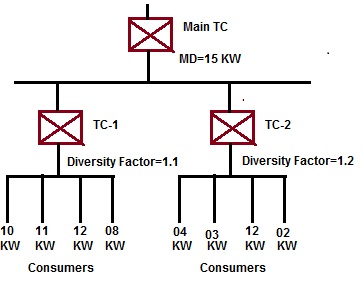
- Total Load on TC-1 =10+11+12+08= 41 KW.
- Maximum Diversity Demand of TC-1= 41 / 1.1 = 37.3 KW.
- Total Load on TC-2 =4+3+12+02= 21 KW.
- Maximum Diversity Demand of TC-2= 21 / 1.2 = 17.5 KW.
- Total Load= 37.3 + 17.5 =54.8 KW.
- Allocating Factor (AF)= M.D / Total Load
- Allocating Factor (AF)= 0.27.
- Actual Load on TC-1=0.27×37.3 = 1.20 KW.
- Actual Load on TC-2=0.27×17.5 = 4.8 KW.
- Assessment of maximum demand is very easy for Resistive Load , For example, the maximum demand of a 240 V single-phase 8 kW shower heater can be calculated by dividing the power (8 kW) by the voltage (240 V) to give a current of 33.3 A. This calculation assumes a power factor of unity, which is a reasonable assumption for such a purely resistive load.
- Lighting circuits pose a special problem when determining MD. Discharge lamps are particularly difficult to assess, and current cannot be calculated simply by dividing lamp power by supply voltage. The reasons for this are Control gear losses result in additional current, the power factor is usually less than unity so current is greater, and Chokes and other control gear usually distort the waveform of the current so that it contains harmonics which are additional to the fundamental supply current.
- So long as the power factor of a discharge lighting circuit is not less than 0.85, the current demand for the circuit can be calculated from:
- current (A) = (lamp power (W) x 1.8) / supply voltage (V)
- For example, the steady state current demand of a 240 V circuit supplying ten 65 W fluorescent lamps would be: I = 10X65X1.8A / 240 = 4.88A
- Switches for circuits feeding discharge lamps must be rated at twice the current they are required to carry, unless they have been specially constructed to withstand the severe arcing resulting from the switching of such inductive and capacitive loads.
Where to use Demand and Diversity factor:
- There is generally confusion between Demand factor and Diversity factor. Demand factors should be ideally applied to individual loads and diversity factor to a group of loads.
- When you talk about ‘diversity’, there are naturally more than one or many loads involved.
- Demand factor can be applied to calculate the size of the sub-main, which is feeding a Sub panel or a fixed load like a motor etc, individual Load.
- Demand factors are more conservative and are used by NEC for service and feeder sizing.
- If the Sub panel have total load is 250 kVA , considering a Demand factor of 0.8, we can size the feeder cable for 250 x 0.8= 200 kVA.
- The Diversity Factor is applied to each group of loads (e.g. being supplied from a distribution or sub-distribution board), size the Transformer.
- Demand factors and diversity factors are used in design. For example, the sum of the connected loads supplied by a feeder is multiplied by the demand factor to determine the load for which the feeder must be sized. This load is termed the maximum demand of the feeder. The sum of the maximum demand loads for a number of sub feeders divided by the diversity factor for the sub feeders will give the maximum demand load to be supplied by the feeder from which the sub feeders are derived.
Calculate Size of Electrical Switchgear by Demand & Diversity Factor:
- The estimated electrical demand for all feeders served directly from the service entrance is calculated by multiplying the total connected loads by their demand factors and then adding all of these together. This sum is divided by the diversity factor (frequently assumed to be unity) to calculate the service entrance demand which is used to determine ampacity requirements for the service entrance conductors.
- When used Diversity and Demand Factor in an electrical design it should be applied as follows, the sum of the connected loads supplied by a feeder-circuit can be multiplied by the demand factor to determine the load used to size the components of the system.
- The sum of the maximum demand loads for two or more feeders is divided by the diversity factor for the feeders to derive the maximum demand load.
- Example-1: Calculate Size of Transformer having following details:
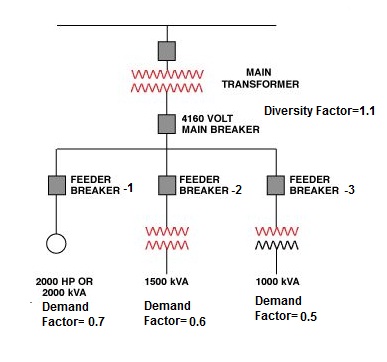
- Feeder Breaker-1 Demand Load= Feeder Breaker-1xDemand Factor.
- Feeder Breaker-1 Demand Load=2000×0.7=1400 KVA
- Feeder Breaker-2 Demand Load= Feeder Breaker-2xDemand Factor.
- Feeder Breaker-2 Demand Load=1500×0.6=900 KVA
- Feeder Breaker-3 Demand Load= Feeder Breaker-3xDemand Factor.
- Feeder Breaker-2 Demand Load=1000×0.5=500 KVA
- Total Feeder Breaker Demand=1400+900+500=2800KVA
- Transformer Demand Load= Total Feeder Breaker Demand / Diversity Factor.
- Transformer Demand Load=2800/1.1 =2545 KVA
- If we Calculated Total Load on Transformer without any Demand & Diversity=2000+1500+1000=4500KVA.
- But after Calculating Demand & Diversity Factor Total Load on Transformer =2545 KVA
- Example-2: Calculate Size of Main Feeder of Main Transformer having following Details:
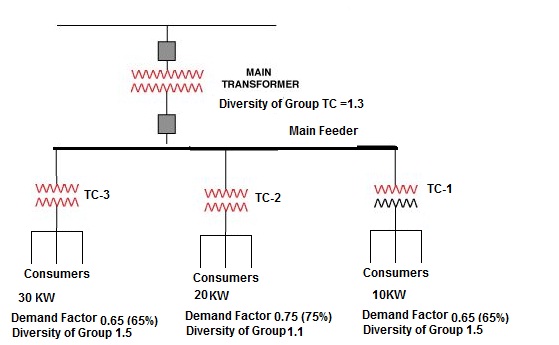
- Sum of Maximum Demand of Customer on TC-1 =10 KWx0.65 =6.5 KW
- Sum of Maximum Demand of Customer on TC-2 =20 KWx0.75 =15 KW
- Sum of Maximum Demand of Customer on TC-3 =30 KWx0.65 =19.5 KW
- As Diversity of Consumer Connected on TC-1 is 1.5 so,
- Maximum Demand on TC-1 =6.5 KW/1.5 = 4 KW.
- As Diversity of Consumer Connected on TC-2 is 1.1 so,
- Maximum Demand on TC-2 =15 KW/1.1 = 14 KW
- As Diversity of Consumer Connected on TC-3 is 1.5 so,
- Maximum Demand on TC-3 =19.5 KW/1.5 = 13 KW.
- Individual Maximum Demand on Main Transformer =04+14+13= 31 KW.
- Maximum Demand on Main Feeder =04+14+13 / 1.3 =24 KW
Significance of Load Factor and Diversity Factor
- Load factor and diversity factor play an important part in the cost of the supply of electrical energy. Higher the values of load factor and diversity factors, lower will be the overall cost per unit generated.
- The capital cost of the power station depends upon the capacity of the power station. Lower the maximum demand of the power station, the lower is the capacity required and therefore lower is the capital cost of the plant. With a given number of consumers the higher the diversity factor of their loads, the smaller will be the capacity of the plant required and consequently the fixed charges due to capital investment will be much reduced.
- Similarly higher load factor means more average load or more number of units generated for a given maximum demand and therefore overall cost per unit of electrical energy generated is reduced due to distribution of standing charges which are proportional to maximum demand and independent of number of units generated.
- Thus the suppliers should always try to improve the load factor as well as diversity factor by inducing the consumers to use the electrical energy during off peak hours and they may be charged at lower rates for such schemes.
 JIGNESH PARMAR





Thank you very much for such a good and detailed article.
Your blog posts are always quite good !
As a junior E&I Engineer, I herewith thank you for your kindness of sharing your knowledge.
I look foreward to more of your work.
Sir,
The informations are very useful like me as Electricity Board Engineer. Thank u and I expect more.
s.sambath
dear sir, thanks a lot both of u i am electrical engineer and i m working in consultancy firm in pakistan
i mostly design high rise official and residential building. i want to share and gain some important knowledge about designing for All of u and every one how help me.
thanks
Zaheer khattak
shaz consultant Peshawar Pakistan
available on Facebook
me from malaysia… u are great sir.. thanks a lot
Dear Mr. Jignesh Parmar,
The details provided by are very useful. Excellent!
I need a small help. I am an Indian, native of Andhra Pradesh. I am a mechanical engineer, handling a new project in Jeddah, Saudi Arabia.
The details in the power summary report are:
Connected Power Usage = 1290KWH
After multiplying by power factors and maximum utilization factors individually to each equipment the sum is = 535 KWH.
Example: Crane connected power = 95 kwh; power factor = 0.6; Max. Utlzn. Factor= 0.75 gives 95kwh X 0.6 X 0.75 = 42.75kwh
Now, If I want buy the generators (OR) to ask for electricity dept. what power should I ask? Will it be 1290KWH or 535 KWH? Please clarify and explain me to improve my awaeness in this perticular topic because always I come across with such incidents.
Please reply to me to my email: (or)
Thanks for your support in advance.
Best Regard
Md.Samiuddin
Plant manager
MIM Co.,
Jeddah
KSA
Thank u very much Mr. Parmar, I really get use and understand these factors which were confused to me. I have set this site in favourities looking foreward to read your good activities.
am very greatful for the explanatory notes, i say well done but needs more of that. thank you
very useful link thank you
Great answer,it really meet my demand
Thank for your kindness, your explanation very useful and very understadble to us….
Thanks for the sharing of your knowledge this s very useful to my design…
can i have the definition of growth factor?
great post! can you explain about peak diversity factor?
what the difference between diversity factor and diversity factor (ks) and where i will use :diversity factor , diversity factor (ks) and demand factor
great, please do more post and detailed explanation
Thank you for your knowledge. This will be of help in my field work.
Thanks very much, I am really enlightened alot.
Dear Mr. Jignesh Parmar,
The details provided about this issue are very useful.
Would you mind informing me about the origin of the table: “Diversity Factor for an apartment block”?
Please answer me by email.
Thanks for your support in advance.
I have already found the referred table in the French Standard “NF C 14-100 (2008): Low-voltage mains installations”.
Please consider the corrections:
– where is “40To 40” should be “40 to 49”
– where is “50 To Above, ks = 0.40” should be “50 to Above, ks = 0.38”.
Thank you sir
thank u sir
Very good article , but these calculation derived from which Code or standard ??? specially table (Demand Factor & Load Factor according to Type of Industries) , because these values is varied and depend on the practice wise
Yes. Agree with you. This is just reference Value .This Value vary according to it’s user’s Profile.
We can not predict the actual value but this table value helpful us to calculate more realistic assumption.
I got this Table from one Book or Manual. If it is more valuable for You than I will defiantly convey it’s Reference Source.
Many thanks for your reply , and i hope to send to me this reference or book it will be a kind from you
Can you please provide me with the reference source? It is very important to me.
Thank you for the great article.
Regards.
I am from US. My name is Ron. I want to talk with you on something. Please tell me what phone # I can call and time. I will call you after getting your 3
I am available on Email.
My Email Id is jiguparmar@yahoo.com
Dear Jignesh, i need the references of your diversity , demand and coincidence factros tables. are they as per any international / national codes. Your kind reply will bne helful in studying a project.
M.A.Bari
Jignesh.Parmar,I need your help.I am fm Bangladesh.Iam also a electrical engineer.I saw that you have most experience in power sector.In15th july,a Bangladeshi power generation company call a interview.I am also a candidate for that interview.Sir please give some materials and tell me how can i got that job.I like to inform you that,I have no experience to work any power plant.I am a fresher electrical engineer
I need your phone # and the time/date
exellent
thanks dear
thanks!!now i know.:)
Hi I have an appartment block with 12 flats to cost and they are all electrily heated toal pot divesity equals 22.4 Kva
ref to (ks) will this factor still apply to the incoming main?
Thank you very much know I am happy
Your first statement regarding demand factor is always less than one.
if your demand factor is 100% that is equal to one.
Philippines
Please carefully Read Definition First !!!
Demand Factor = Maximum demand of a system / Total connected load on the system.
Your max demand never goes beyond connected load so D.F is always less than 1.
Hope this clarification may clear your dough.
Dear sir,
I came across another formula like
Maximum normal running plant load = 100% sum of all continuously operating loads + 30% sum of all intermittent loads.
Where 100% and 30% are considered as the diversity factors of continuous and intermittent loads respectively
Sir do you know which industry is this formula commonly used. can you explain this formula..
I hope you will reply to my question
Thank You Mr. Jignesh Parmar. It is very useful in designing of electrical installtion.
Dear Sir, I would like to learn about the reference for this info.Thank you very much for your kind help.
Dear sir, one confusion is that if my conected load is 450 kw and consumption is 307 kwh then what the rating of incomming transformer please tell me brief.
Thank You Mr.Jignesh Parmar.
very usefull things u have given, thanks,
thank you very much.
this is a test
thank uuu
nice and simple information thanks for your effort
what is the demand factor and load factor for drafting room?
Basically, these data for the DEMAND and DIVERSITY factors are excellent info for a fast estimation of POWER SUPPLY, CABLE / WIRE SIZES, many thanks
thanks for the article….. it helped me. thanks
Your effort is laudable. We stand to gain with your sharing in a simple way.
thanks for useful And applicable kno
wlge
Thank you Mr. Jignesh! Nice explanations of these Electricity factors in one Article.
Harish Kumar Johri, L&T Faridabad.
Thanks for this note, hopefully can i know what is your reference for this … Im glad to know…thanks in advance
Am appreciation for this provision of the infomatiom about diversity factor bcause its always difficult to find reliable notes for this topic.
your article is always edifying my studies. May God Bless you more and more
how can get this paper
thank you very much for such valuable informations
Very simple explanation and really valuable .
This is an antibiotic for my knowledge
dear Jignesh
i have a small question regarding the transformers.
i need to know according to NEC what is the percentage to be loaded for the capacity of a transformer.
As a practice we always consider 80% of total kva of a transformer.
ex. if we have 1600 kva t/r then we can use 1600*80% = 1280 kva.
we can use only 1280kva instead of 1600 kva. supoose your total load is 1400 kva then you have to go to higher size that is 2000 kva.
nice effort for making it understandable to non technical also..
Sir ,thanks for providing useful information as it helps in preparation of amie
great notes but alot of spelling mistakes
i am plant engineer(electrcial).dis concept always we r using, so undestand the LF,DF etc..
Dear sir,
Actually sir, Could you please more detail for me about what is the Ku and What is the Ks cos i still confuse with what you showed above.
Best regard,
sir i am electrical engg. student i want to write research paper on rural electricity so could you help me
thank you for this information but i have an Question :- if i have 2000kw connected load than how much kva transformer we should use either higher from 2000kw or below. according to your calculation it give very low capacity capacity of transformer. please reply.
Thank you for sharing your knowledge!!
Dear Mr.Jignesh.Parmar
Thank you for your idea and implementation of sharing your experience & knowledge and help technical enthusiasts to learn more.
GREAT THINKING; GREAT JOB!
+32.thanks very good site ,thank for help
Chandrakant Ghan:
Dear Mr.Parmar, A very useful article and clears many doubts about the factors in Electrical isntalltion.
Thanks for such article.
Regards
what is the capacity of transformer for 33000sq feet area pls suggested
Dear Mr Parmar
We are currently working on a project for Lagos State Ministry of Housing- a total of 53blocks. Each block is a four floors comprises of 8Nos -1 bedroom flat (2 nos per floor) on a wing and 8Nos -2 bedroom flat (2Nos per floor) on the other wing. The total load for each block is 478.4KW and for all the 53 blocks, the total load was 25,355.2KW i.e 25.355MW.
Selecting Transformers for the Estate:
A diversity factor of 0.8 (1.25) was apply for each block and a load factor of 0.3 was used for the entire estate , en block
The total utility factor applied for the entire Estate is 0.8 multiply by 0.3 = 0.24
Total estimated load for selection of Transformer is 25.355MW X 0.24 = 6.085MW
Applying power factor of 0.8, estimated load in KVA = 7,606KVA
Number of Transformer required (Assumed each selected Transformer is of (500KVA) = 7,606/500No = 15.2 say 16No of 500KVA will be required for the Estate.
I need your advice and I want to know if there is a Regulation that confirm the above application factor for final load (Estimated) as done above.
I want to know if I am on the right track considering your definition of diversity factor, load factor etc.
Base on the above calculation what is the size of the main injection substation that will supply the entire estate. Thank you.
Thank you as I expect to hear from you soonest.
Dear Mr. Parmar Ji,
I also want Reply on above matter. I have same type of issue of multi story building .In my area Electricity Board Recommend 50% Demand Factor and as per diversity factor above 80 Flats in one block we use 40% Diversity Factor but we want to use 60% and total utility factor 0.30 instead of 0.2.But our Designer recommended unity diversity factor. So Please suggest
Thanks a lot Sir. These information were very useful.
I like to read your answers… i would like to Size of Generator for my new Plant. Pl advice how to arrive correct size of DG set. similarly, if i want to do same from running plant, pl specify the same also.. thanks..venkat
Is diversity factor same as utilisation factor
Thank you a lot sir
very useful article . thank you sir
Sir
Mingalarbar !!!!
My name is Ye from myanmar and work on some of electrical design for building.I am one of the reader of your blog and EEP. I request the some question for my confusion.
1.Demand Factor must be applied to each individual load such as lighting and small receptacle etc,.
2.Dirversity factor or simultaneity factor is applied to each group of load such as DB or SDB.
3.Dirversity factor (Ks) > 1 but Ks of the DB and circuit function is less than 1. What does is mean?
4.Are the Dirversity factor as per circuit function used by DB or individual load.
5.Is the IEE on site guide book Table 1B allowances of dervsity used the individual circuit?Now we are using this table for demand factor.Is it correct?
If you don’t mind, please the above questions because we are not clear the demand ,dirversity and coincidence factor really and is not satisfy.So please make sure and explain my questions if you can.
I am waiting your answers.
Learning to forwards.……………
Thank
B.Rgd;
Ye Lwin Aung
Amazing article
Can load factor be used to identify diverted or fraudulent customers that have one-hour interval Smart meter KWH reads? Looking for analytics to identify diverted air conditioner and pool pump loads? Would there be any benefit to comparing load factor readings on similar size homes to find this type of diversion?
Thanks
Wow!
Its very helpful information for fresh as well as experienced engineers to expand their knowledge.
Thanks a lot for sharing
Dear Jignesh sir
Can I consider same factors for sizing of diesel as well a gas generator ? Pls suggest.
super
Best Article and good examples to clear the idea of different factors
Dear Mr. Jignesh Parmar
Thank you very much for providing such an excellent resource. Great work sir. Keep it up.
With best regards
Tariq Syed
Retired country manager
Trend Controls
Honeywell – Saudi Arabia
Very useful and simply describe all points. Thank you
Sir,
Thanks I learned a lot of your blog.
regards,
Fidel
I have following observations on your article.:-
1) Demand factors shall be as per NEC 2017.
2) To get total demand load add 10% spare capacity to size MCC or SWGRS
3) To size XFRs consider de-rating factor of 15% or divide by 0.85
sir,
Greetings,
your inputs are based on our IE Standard or IS Standards
Thankful
Best Regards
A. Renjith
For selection of transformer using diversity factor,Imagine a load of 500KVA is given without the type of load.How much diversity we consider so that the transformer donot gets tripped?
you have trade off between saving money and problem when full load
Great article
Thank you sir
can i get load factors for each customer class?
Lots of thank for your information and your simple way to give it.
Great Helpful article
Very useful material and highly educative.
Thank you for the very useful article.
Thank you for detailed clarification of such hard for understanding issues.
Hi, thanks for the information.
very useful, thank u very much
I think this really tricky for in my office for example we get in we start 12 split units and all the lights how can one apply demand factor from what is mentioned above? really looking forward to your answer thanks